No major spoiler is required for this comparison. Names of progression systems and broad endgame features are mentioned, but individual unlock paths are not listed.
Fast answer
The answer before the background
Nordic Ashes vs Vampire Survivors is mainly a choice between structured build planning and effortless accessibility. Pick Nordic Ashes if you want character-specific weapons, constellation upgrades, relic synergies, several modes, and tougher map objectives. Pick Vampire Survivors if you want the cleanest survivor-like formula, fast unlocks, easy-to-read runs, local co-op, and a large library of themed expansions. For a third option, choose Soulstone Survivors when active abilities, crafting, bosses, and high-volume build experimentation matter more than either game’s simpler presentation.
The short verdict
What is the biggest difference?
Both games use the familiar survivor-like loop: move through enemy pressure, collect experience, choose upgrades, and try to turn a fragile opening into a powerful late run. The difference is where each game puts its complexity.
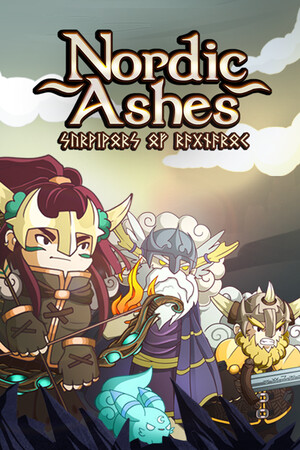
Nordic Ashes puts more emphasis on the identity of the survivor you choose. Its Steam description highlights dedicated weapons and skills, character constellation trees, a separate Yggdrasil metaprogression tree, relics, mastery, ascensions, multiple modes, and realm-specific bosses. That makes each run feel more like solving a character build than simply assembling a strong weapon package.
Vampire Survivors is the cleaner entry point. Its official description presents time survival, minimal controls, roguelite progression, gold-funded upgrades, and local co-op for up to four players. The basic loop is easier to understand immediately, while its depth grows through unlocks, evolutions, characters, secrets, and expansions.
- Choose Nordic Ashes if you want more decisions about how a character’s kit develops.
- Choose Vampire Survivors if you want to learn the genre with minimal friction.
- Neither is universally better; they reward different kinds of attention.
| If you value... | Better choice | Why |
|---|---|---|
| Character identity and planned progression | Nordic Ashes | Weapons, constellations, relics, mastery, and ascensions make the chosen survivor important. |
| Simple controls and quick experimentation | Vampire Survivors | The core loop is immediately readable and supports rapid build testing. |
| Co-op on one system | Vampire Survivors | The Steam page explicitly lists local co-op for up to four players. |
| A more demanding solo build puzzle | Nordic Ashes | Realm objectives, elites, bosses, and layered progression create more pressure on route and upgrade choices. |
Start with Vampire Survivors if you are new to the genre or want a relaxed pick-up-and-play game. Start with Nordic Ashes if you already understand survivor-likes and want more build structure from the beginning.
Build advice
Attack speed versus cooldown in Nordic Ashes
The terms are easy to confuse because both can make an attack appear more frequent, but they should not automatically be treated as identical. Attack speed can describe how quickly a weapon performs or cycles its individual attack behavior. Cooldown can describe the delay before the ability becomes available again. A multi-hit or persistent attack may therefore respond differently to the two stats.
The practical answer to “Nordic Ashes attack speed vs cooldown” is to inspect the specific weapon or ability rather than applying one universal rule. Community testing has documented attacks with separate attack-speed and cooldown values, which is useful evidence that the distinction matters, but it is not a substitute for the current in-game description or a controlled test on your version.
Use this three-step check when comparing upgrades: first record the attack’s visible behavior; second take one upgrade and repeat the same test against a safe target or fixed enemy group; third compare damage over time rather than judging only the animation. A faster animation is not automatically better if the ability’s damage, projectiles, duration, or number of hits remains unchanged.
For the broader question of “Nordic Ashes cooldown vs attack speed,” prioritize the stat that governs the part of the attack your build actually relies on. Choose cooldown for a powerful ability that has a meaningful waiting period. Choose attack speed when the weapon repeatedly performs short attack cycles or benefits from more frequent contact. If the interface does not explain the interaction clearly, treat the result as version-sensitive instead of assuming a hidden formula.
- Do not compare the displayed numbers without checking the weapon’s wording.
- Test sustained damage over several seconds, not one attack animation.
- Persistent, multi-hit, and triggered abilities may scale differently.
- If two upgrades look close, choose the one that also improves your defensive or control plan.
| Build situation | Usually test first | Reason |
|---|---|---|
| Large burst ability with a long wait | Cooldown | More frequent casts may produce the biggest gain. |
| Rapid repeated attack | Attack speed | The weapon may gain more actions during the same period. |
| Persistent area effect | Duration and cooldown together | More uptime can matter more than faster visual ticks. |
| Unclear or unusual weapon | Both in a controlled test | The game may apply the stats differently by ability. |
The existence of separate attack-speed and cooldown values is supported by community testing, but a universal conversion formula is not established by the official store page. Use the current game’s tooltip and your own test as the final authority.
Alternatives
Where does Soulstone Survivors fit?
Soulstone Survivors is the most obvious alternative when neither comparison feels quite right. Its official page describes a fast-paced action roguelite built around active skills, hundreds of abilities, bosses, a large skill tree, weapon crafting, curses, varied maps, and multiple modes.
Compared with Nordic Ashes, it leans harder into active ability selection and build engineering. You are likely to spend more time thinking about skill combinations, weapon construction, status effects, and how a run scales toward extreme power. That makes it a strong choice for players who enjoy theorycrafting and deliberately breaking a build.
Compared with Vampire Survivors, it is less minimal. It asks more from the player during a run and presents a more elaborate progression structure. The trade-off is that its breadth can feel less immediately relaxing, especially if you prefer the original formula’s straightforward movement-and-upgrade rhythm.
The decision is therefore simple: choose Soulstone Survivors for the deepest build sandbox of these three; choose Nordic Ashes for a more character-led Norse setting and realm structure; choose Vampire Survivors for the most approachable foundation and local co-op.
- Pick Soulstone Survivors for active skills, crafting, bosses, and very large build variety.
- Pick Nordic Ashes for character-specific progression and Norse-themed realm challenges.
- Pick Vampire Survivors for the simplest controls and the easiest casual sessions.
| Game | Best for | Main trade-off |
|---|---|---|
| Nordic Ashes | Character-focused builds and structured solo progression | More systems to learn and more reliance on the chosen survivor. |
| Vampire Survivors | Accessible runs, secrets, and local co-op | Less emphasis on character-specific build planning in the basic loop. |
| Soulstone Survivors | Active-skill theorycrafting and crafting | A busier interface and more demanding build decisions. |
Buying decision
A practical way to choose
Choose Nordic Ashes if you want a game that keeps giving you reasons to revisit individual characters. Its constellation trees, relics, mastery, multiple modes, elite enemies, bosses, and realm progression give long-term goals beyond simply surviving one timer.
Choose Vampire Survivors if you want a reliable first purchase for short sessions or shared play. Its official starting tips also encourage focusing on a few offensive weapons, levelling them one at a time, and experimenting with refunded power-ups. That makes it friendly to players who would rather learn through repeated runs than study a build planner.
Choose Soulstone Survivors if you enjoy comparing many possible combinations and do not mind spending more time learning the system. Its official feature list specifically emphasizes 350-plus skills, more than 100 craftable weapons, a deep skill tree, curses, bosses, and different game modes.
Before buying, check three things on your platform: whether local co-op matters, whether you prefer active or mostly automatic attacks, and whether you want a character-led progression system or a simpler universal loop. Also check the current edition and DLC list, because all three games have received substantial post-launch content.
- For a first survivor-like: Vampire Survivors.
- For deeper solo progression: Nordic Ashes.
- For the biggest build-crafting sandbox: Soulstone Survivors.
- For local co-op: Vampire Survivors, based on the current official Steam listing.
There is no single winner for every player. The safest recommendation is Vampire Survivors for accessibility, Nordic Ashes for structured character progression, and Soulstone Survivors for high-complexity build crafting.
FAQ
Common questions
Is Nordic Ashes harder than Vampire Survivors?
Generally, it feels more demanding because its realms, character systems, relic choices, elites, bosses, and challenge modes create more decisions during a run. Difficulty can still vary by character, mode, build, and current balance patch, so treat this as a playstyle comparison rather than a fixed ranking.
Is attack speed better than cooldown in Nordic Ashes?
Not universally. Attack speed and cooldown can affect different parts of an ability. Check the weapon tooltip, then compare sustained damage after taking one upgrade. A long-cooldown burst ability often values cooldown, while a repeatedly cycling weapon may value attack speed.
Is Soulstone Survivors better than Nordic Ashes?
It is better if you want active skills, crafting, bosses, and a very large build system. Nordic Ashes is the better fit if you prefer character-specific weapons, constellation progression, Norse-themed realms, and a more focused solo structure.
Which game is best for beginners?
Vampire Survivors is the easiest starting point because its basic controls and objective are immediately clear. Nordic Ashes is a good second step for players who want more progression layers, while Soulstone Survivors suits beginners who already enjoy theorycrafting-heavy roguelites.
Which game has local co-op?
The current official Vampire Survivors Steam listing explicitly supports local co-op for up to four players. Do not assume the same feature exists in the other two games without checking their current platform listings.
Sources
What we checked
Official listings establish current availability and product facts. Community pages are used for mechanics and build history, then labeled separately.