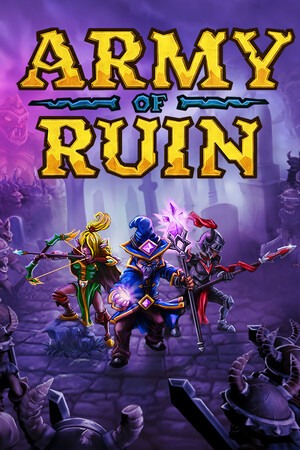
This guide discusses enemy pressure, failure, and challenge conditions, but contains no story spoilers.
Fast answer
The answer before the background
For your first several runs, choose a hero you can control comfortably, stay near enough to collect experience, and take upgrades that improve immediate survival or reliable area coverage. Do not spread every level-up across unrelated weapons. Build a small core, learn when elites and bosses arrive, then spend earned currency on permanent improvements and new unlocks. Clear early stages normally before attempting restrictive challenges, and use the post-stage results to identify which weapon, trinket, or stat caused the failure. The safest progression is ordinary clears, equipment unlocks, star collection, higher Ruin levels, then focused challenge and achievement cleanup.
Start here
Your first five minutes
Army of Ruin is an auto-shooter, so your main job is positioning, targeting, and choosing upgrades. Damage happens automatically, but survival does not. Begin by moving in wide arcs rather than running directly through enemies or hugging the edge of the arena.
Collect enough experience to keep leveling, but do not chase every pickup into a dangerous pack. A short detour is worthwhile when the path is clear; a long detour usually costs more health than the reward is worth. Keep an escape route open, especially before an elite or boss appears.
For the opening levels, take one dependable damage tool and one defensive or control option. Area damage, piercing, knockback, slowing, or a similar effect helps manage crowds, while movement speed, health, armor, or recovery gives you room to make mistakes. The exact best choice depends on the hero and the equipment already unlocked, so avoid treating a community tier list as a universal answer.
- Level the weapon that is already clearing enemies instead of immediately collecting six unrelated options.
- Move through open space and change direction before enemies surround you.
- Save emergency healing or defensive effects for the point where they prevent a death, not merely for minor damage.
- If aiming is available for your weapon, use it for short controlled attacks rather than standing still in a crowd.
| Situation | Safer response | Common bad response |
|---|---|---|
| A dense wave approaches | Circle around its edge while your area damage works | Walk straight through the center |
| You are behind on experience | Take a clear nearby route and return later | Chase a distant pickup through enemies |
| A boss enters | Keep an escape lane and attack while moving | Stop to maximize one directional attack |
| A challenge requires no movement | Prepare a stationary build before starting it | Attempt it with a normal roaming setup |
The official store describes the game as an auto-shooter built around heroes, weapons, equipment, trinkets, evolving combinations, and hundreds of challenges. Recommendations in this section are strategy advice, not claims that one item is mathematically best.
Build discipline
Upgrade priorities that work
A useful run has a plan. Your first priority is enough damage to prevent enemies from closing in. Your second is consistency: improve the weapon or effect that already solves your main problem. Your third is specialization, such as adding a compatible evolution, stronger control, or a defensive layer.
Avoid taking every attractive upgrade. A spread of low-level weapons can look powerful in the selection screen but leave you with no fully developed tool when enemy health rises. In most runs, a compact collection of well-supported weapons is easier to pilot than a crowded collection of half-finished ideas.
Use trinkets and hero skills to repair weaknesses. A slow hero may value movement support; a fragile hero may need protection before extra damage; a directional weapon may need positioning help. This is a recommendation rather than a fixed rule, because the correct trade-off changes with the stage and challenge.
When you unlock a weapon evolution, test what it actually does in a normal stage before building an achievement attempt around it. The official update history confirms that evolutions, trinkets, characters, charms, and challenges have been added over time, while later balance updates have changed individual weapons. That is why this guide does not promise a permanent best build.
- Early run: secure one reliable damage source and one safety option.
- Middle run: improve the damage source, then add coverage for enemies your first tool misses.
- Late run: complete the intended combination, fill remaining slots with support, and stop taking upgrades that do not help the plan.
- Before a special challenge: read its restriction and rebuild around that restriction rather than forcing your normal loadout.
| Priority | Why it matters | When to break the rule |
|---|---|---|
| Reliable damage | Prevents crowd buildup and protects future choices | If the stage specifically tests defense or no attacks |
| Survivability | Converts small mistakes into recoverable mistakes | If your damage is too low to reach the next power spike |
| Synergy | Makes evolutions and support effects more valuable | If the offered choices are poor or unsafe |
| Utility | Helps with movement, pickups, or a challenge condition | When a direct damage upgrade is clearly needed immediately |
Do not restart because the first few level-ups were imperfect. Restart only when the run has a clear structural problem, such as no crowd control, no escape tool, or a challenge condition that the current build cannot satisfy.
Progression route
What to do after a failed run
Treat failure as information. Check whether you died because enemies caught you, the boss took too long, a directional attack was difficult to aim, or a challenge restriction invalidated your usual movement. Change one or two causes on the next attempt so you can tell what helped.
Your general route should be straightforward. First, clear early stages normally and learn their layouts. Next, spend permanent currency on upgrades or unlocks that improve your baseline options. Then experiment with newly unlocked characters, weapons, trinkets, charms, and features. After ordinary clears become repeatable, begin collecting stars and testing Ruin levels. Leave highly restrictive challenges and final achievement cleanup for later unless you enjoy solving them early.
The official game history confirms that the title added Ruin levels, Turbo or speed options, Endless stages, achievements, new areas, an in-game map, and Favorites over its development. These additions create separate goals, not a single mandatory order. A new player should use the order above because it limits frustration and lets permanent progress carry into future attempts.
For completion-focused play, keep a checklist of stage clears, character-specific tasks, equipment unlocks, and challenge conditions. Do not assume every achievement is obtained by simply finishing stages. Community achievement references show objectives involving specific heroes, stages, upgrades, infusions, damage-free clears, movement restrictions, and spending limits.
- Normal clears first: learn waves, bosses, pickups, and routes.
- Permanent progress second: improve the account and enlarge the pool of viable builds.
- Stars and Ruin levels third: raise difficulty after your baseline build is reliable.
- Challenge cleanup last: prepare a dedicated loadout for each unusual condition.
- Endless mode is optional practice and endurance content, not a prerequisite for learning the opening stages.
| Stage of progression | Main goal | Best mindset |
|---|---|---|
| Early clears | Learn controls and survive | Consistency matters more than speed |
| Unlocking phase | Expand equipment and hero options | Test items without chasing perfection |
| Ruin phase | Handle stronger enemies and tighter decisions | Spend upgrades deliberately |
| Completion phase | Solve restrictive objectives | Build for the condition, not habit |
The exact order of unlocks and the availability of some content can vary by platform, save state, or later patch behavior. If an objective does not appear when expected, verify the in-game requirement rather than relying on an old guide.
Avoid these traps
Common mistakes and quick fixes
The most common mistake is prioritizing damage so aggressively that one mistake ends the run. A second is moving constantly without collecting experience, which creates a weak build even when the character remains healthy. The opposite mistake is standing still to aim or farm when the stage has not been prepared for it.
Another frequent problem is spending every resource immediately. Keep enough flexibility to respond to a bad level-up sequence, and use rerolls or banishes when a choice actively damages the plan. Do not spend them automatically; their value is highest when the offered options are dangerous or useless.
Players also often attempt high-speed settings too early. The developer has stated that increasing speed makes games shorter but harder. Use normal speed while learning a stage, then increase it only when you can already recognize the important wave timings.
Finally, do not copy a build without checking its assumptions. A guide may depend on a particular unlock, a specific hero, a completed weapon pool, or an older balance state.
- Do not chase a chest or pickup through a sealed path.
- Do not take a new weapon merely because its icon is unfamiliar or rare.
- Do not attempt a no-hit or no-movement objective with a general-purpose build.
- Do not judge a weapon after one unlucky level-up sequence.
- Do not confuse faster completion with safer progression.
| Mistake | Why it fails | Fix |
|---|---|---|
| Too many unrelated weapons | No tool reaches a decisive power level | Commit to a small core |
| Ignoring movement | Enemies eventually remove every escape lane | Practice circular routes |
| Saving every reroll | Bad choices compound into a weak run | Spend resources when they protect the plan |
| Using speed settings while learning | Timing errors become harder to recover from | Return to normal speed |
| Copying old tier lists | Balance and content can change | Use principles and test current results |
If a run fails twice for the same reason, change the build or route before increasing difficulty. Repeating the identical attempt usually teaches less than one deliberate adjustment.
FAQ
Common questions
Is there one best starting build?
No verified universal build should be treated as permanent. Start with reliable area damage, one defensive or control option, and support that matches the hero. Then adapt to the stage and the choices offered.
When should I use Turbo or faster speed settings?
Use them after you can clear the stage comfortably at normal speed. The developer specifically warns that faster time scale makes the game harder, so it is better viewed as an efficiency option than as a beginner setting.
How should I approach an achievement or trophy guide?
Finish ordinary stage clears and unlock a broad equipment pool first. Then group objectives by condition, such as a specific hero, no damage, no movement, upgrade limits, or weapon requirements. Build for one condition at a time instead of mixing incompatible goals.
Should I prioritize permanent upgrades or new equipment?
Use permanent upgrades when they improve repeated failures, such as weak survivability or poor economy. Choose new equipment when your current pool leaves you unable to solve a stage or challenge. The best choice is the one that fixes the cause of your last failure.
Are community build lists still reliable?
They can be useful for ideas, but check their date and assumptions. Official updates have changed balance, aiming, speed options, achievements, and available content, so test recommendations in your current version before committing to a long completion run.
Sources
What we checked
Official listings establish current availability and product facts. Community pages are used for mechanics and build history, then labeled separately.
- OfficialOfficial Steam store page and feature list
- OfficialOfficial Steam news feed with current update history
- OfficialMilkstone Studios: Early Access Update #19, Hidden Shrine, map, Favorites, and unlocks
- OfficialMilkstone Studios: Update #1, speed settings and aiming options
- CommunitySteam Community guides and achievement references
- ReferenceExophase achievement reference